Time Savings Calculator
Calculate how much time you could save annually by living in a luxury apartment with premium services.
Your Time Savings
= More than 1 full month of time saved per year
People don’t just live in luxury apartments because they can afford them. They live there because it changes how they experience everyday life. It’s not about showing off. It’s about peace, control, and convenience built into the walls, floors, and ceilings of the place they call home.
It’s Not Just About Space
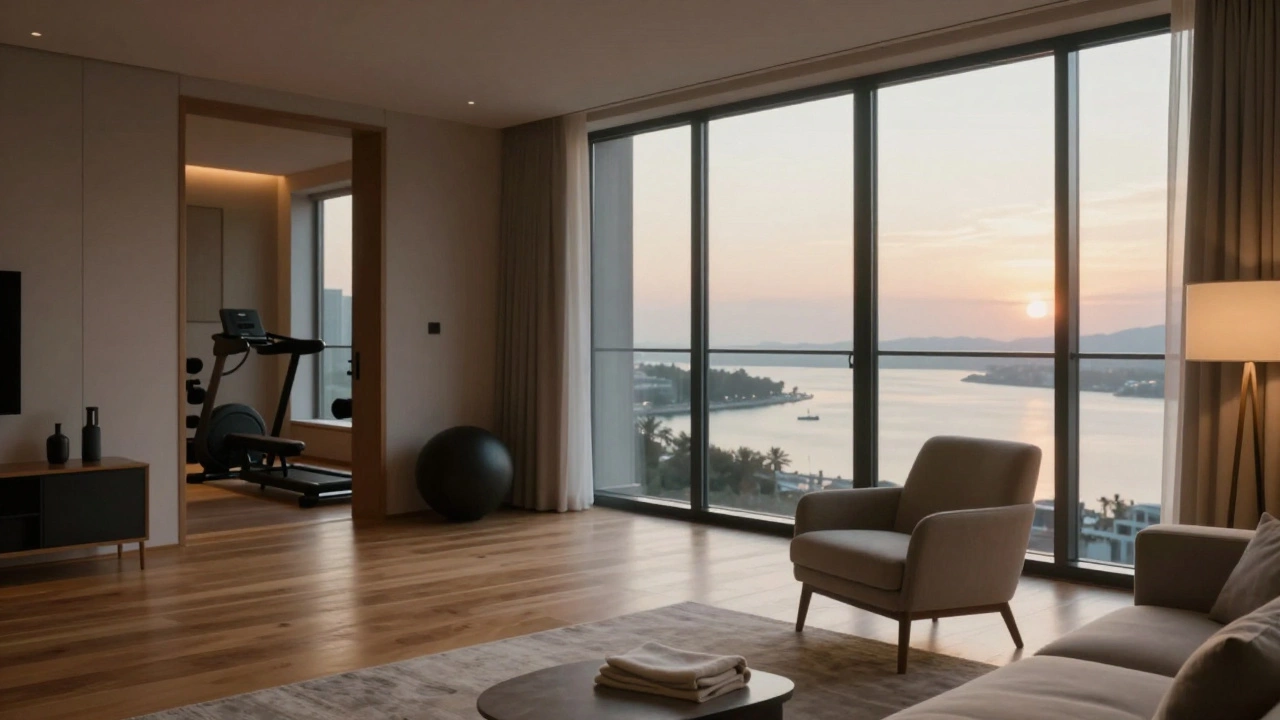
Yes, luxury apartments are bigger. But that’s not why people choose them. A 3,000-square-foot penthouse in Manhattan or Auckland’s Viaduct Harbour doesn’t win people over because of square footage alone. It’s what that space gives them: a private gym with floor-to-ceiling windows overlooking the harbor, a soundproofed home theater that feels like a private cinema, or a chef’s kitchen with dual dishwashers and a walk-in pantry so organized it makes meal prep feel like a ritual.
These aren’t gimmicks. They’re solutions to real frustrations. Think about how often you’ve had to wait for a gym slot, or how noisy your neighbors are. Luxury apartments remove those friction points. You don’t need to leave your building to work out. You don’t hear the TV next door. You don’t fight for parking. That kind of predictability? It’s priceless.
Security That Feels Invisible
When you walk into a luxury apartment building, you don’t see armed guards. You don’t see bulletproof glass. But you feel it.
Keycard access that logs every entry. 24/7 concierge who knows your name and your dog’s name. Surveillance cameras that don’t stare but still watch. Package delivery that goes straight to a climate-controlled locker. These systems aren’t flashy. They’re quiet. And that’s the point.
People who live in luxury apartments aren’t paranoid. They’re practical. They’ve seen what happens when security is an afterthought. A stolen bike. A package gone missing. A break-in in a building with no staff after 10 p.m. Luxury buildings prevent those things before they happen. That’s not luxury. That’s peace of mind.
Services That Do the Heavy Lifting
Imagine never having to arrange for dry cleaning. Or scheduling a plumber. Or finding someone to clean your windows. In luxury apartments, those tasks don’t disappear-they get handed off.
Concierge teams handle everything from booking dinner reservations to arranging last-minute travel. Housekeeping services come weekly, sometimes daily. Valet parking, pet walking, even grocery delivery from curated local vendors-all part of the package. It’s not about being waited on. It’s about reclaiming time.
A 2025 survey of high-income urban residents found that people living in luxury apartments saved an average of 12 hours per week on household chores and errands. That’s 624 hours a year. More than a full month. That time doesn’t go to Netflix. It goes to family, hobbies, sleep, or simply being still.

Design That Doesn’t Compromise
Luxury apartments don’t use ‘designer’ as a buzzword. They use it as a standard.
Think solid oak floors, not laminate. Italian marble countertops, not quartz imitations. Smart thermostats that learn your rhythm. Underfloor heating that turns on before you wake up. Noise-reducing walls built with triple-layer insulation. Windows sealed to block outside sound without blocking light.
These aren’t upgrades. They’re expectations. People who choose these spaces are tired of living in buildings that feel like rental units with a price tag. They want materials that age gracefully. Systems that work without yelling for attention. Lighting that adjusts to the time of day, not just a manual switch.
It’s the difference between a home that looks good in photos and one that feels good in real life.
Community Without the Crowds
Luxury apartments aren’t isolated. They’re curated.
Resident lounges with fireplaces and wine bars. Rooftop gardens with herb beds and private seating. Yoga studios that open at 6 a.m. for early risers. These aren’t just amenities-they’re social spaces designed for people who want connection without the chaos.
There’s no forced mingling. No block parties with strangers. But if you want to meet someone who shares your rhythm-someone who also runs at sunrise, or reads on the balcony at dusk-you can. The structure makes it easy. No awkward small talk required.
In cities where loneliness is rising, luxury buildings quietly solve it. Not by throwing events, but by creating spaces where meaningful connections happen naturally.

Location, But Not Just Any Location
Most luxury apartments sit in places most people can’t reach.
Not because they’re far out. But because they’re right in the middle-of culture, of business, of transit. A 10-minute walk to a Michelin-starred restaurant. A five-minute ride to the airport. A subway stop under the building. A riverfront path that runs past your front door.
People who live in luxury apartments aren’t avoiding the city. They’re claiming the best parts of it. They don’t want to escape urban life. They want to live at its center, without the noise, the traffic, or the compromises.
That’s why prices stay high. It’s not just the building. It’s the address. The access. The proximity to everything that matters.
It’s a Lifestyle Choice, Not a Status Symbol
Some think luxury apartments are about showing off. They’re wrong.
The people who live in them don’t post photos of their views. They don’t brag about their penthouse. They’re too busy enjoying the quiet mornings, the effortless routines, the freedom from daily hassles.
Luxury living isn’t about having more. It’s about needing less. Less stress. Less waiting. Less compromise.
It’s about knowing that when you walk through the door, everything just works. And that’s worth more than any price tag.
Are luxury apartments only for the ultra-rich?
Not necessarily. While some luxury apartments cost millions, others are priced in the upper-middle range-especially in cities like Auckland, Melbourne, or Vancouver. Many are rented, not bought. A well-located luxury rental can cost $5,000-$8,000 per month, which is steep, but within reach for high-income professionals, entrepreneurs, or dual-income households. The real barrier isn’t wealth-it’s availability. These units are limited, and demand is high.
Do luxury apartments hold their value better than regular condos?
Yes, historically they do. Data from urban real estate markets in 2024 and 2025 show luxury apartments in major cities depreciated 30% slower than standard condos during economic downturns. Why? Because their appeal isn’t tied to trends. People always want convenience, security, and quality. During inflation or uncertainty, these features become even more valuable. They’re not just homes-they’re stable assets.
Is it worth paying more for a luxury apartment if I’m not home much?
Even if you’re away often, the value shows up in how the space feels when you return. A quiet, clean, perfectly maintained home is a reset. No clutter. No noise. No maintenance headaches. That’s restorative. Also, luxury rentals often include services like cleaning and laundry, which means your home stays lived-in even when you’re not there. For frequent travelers or remote workers, that consistency matters more than you think.
What’s the biggest mistake people make when choosing a luxury apartment?
Focusing on finishes instead of systems. A marble countertop looks impressive. But if the HVAC system is outdated, the elevators break down monthly, or the soundproofing is thin, you’ll regret it. Always ask about building management, maintenance records, and service response times. The best luxury apartments don’t just look expensive-they operate like fine-tuned machines.
Do luxury apartments have hidden fees?
Yes, but they’re predictable. Monthly fees usually cover everything: maintenance, utilities, concierge, security, building insurance, and sometimes even Wi-Fi and streaming services. The trick is to ask for a detailed breakdown before signing. Some buildings charge extra for parking, pet fees, or storage. If those aren’t included, you’ll need to factor them in. But unlike regular apartments, there are rarely surprise repair bills-those are covered by the building’s management fund.