
FHA Loan Income Calculator
Calculate your required income to qualify for a $400k FHA loan based on your debt and expenses. This tool helps you see if you meet lender requirements for the 31% front-end ratio and 43% back-end ratio.
Results
Enter your details above to see your income requirement.
Note: Lenders typically use the higher of the two income requirements shown below.
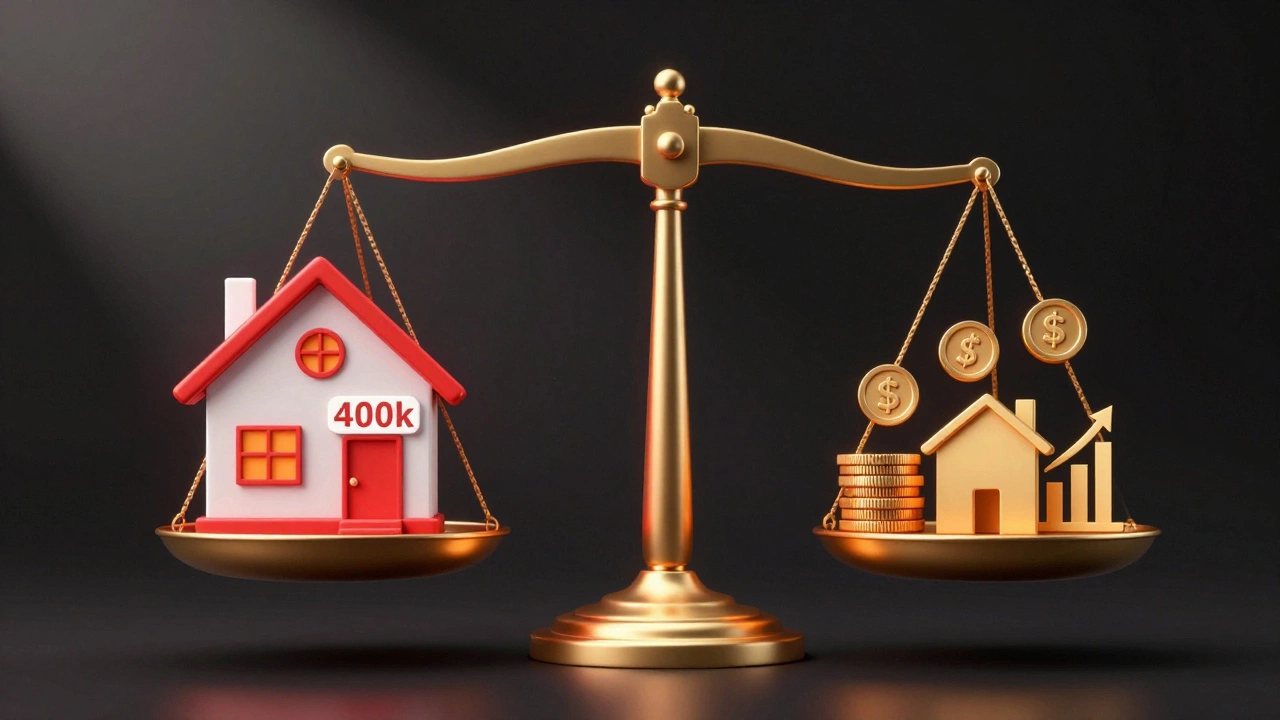
Buying a $400,000 home with an FHA loan is a realistic goal for many first-time buyers-but only if your income meets the lender’s requirements. FHA loans are designed to help people with lower credit scores and smaller down payments get into homes, but they still have strict rules about how much you can borrow based on what you earn. So how much income do you actually need? Let’s cut through the noise and give you the real numbers, based on current guidelines as of 2026.
Understanding FHA Loan Rules in 2026
FHA loans are backed by the Federal Housing Administration, which means lenders take less risk when approving them. That’s why they allow down payments as low as 3.5% and credit scores as low as 580. But here’s the catch: the FHA doesn’t set your income limit. Your lender does. And lenders follow two main rules to decide if you can afford the loan: the debt-to-income ratio (DTI) and the front-end ratio.
The front-end ratio looks at your monthly housing costs-your mortgage payment, property taxes, homeowners insurance, and FHA mortgage insurance premium-and compares them to your gross monthly income. Most lenders want this number to be no higher than 31%. The back-end ratio looks at all your monthly debts-including car loans, student loans, credit cards, and child support-and wants that total to stay under 43%.
These numbers aren’t flexible. If you’re at 45% DTI, you won’t qualify, no matter how good your credit is.
Calculating Income Needed for a $400k FHA Loan
Let’s break this down with real numbers. For a $400,000 home with a 3.5% down payment, you’d put down $14,000 and borrow $386,000. Assuming a 30-year fixed FHA loan with an interest rate of 6.25% (as of early 2026), your monthly principal and interest payment would be about $2,380.
Now add the other costs:
- Property taxes: $4,200 per year ($350/month)
- Homeowners insurance: $1,200 per year ($100/month)
- FHA mortgage insurance premium (MIP): $2,000 per year ($167/month)
That brings your total monthly housing payment to around $2,997.
To meet the 31% front-end ratio, your gross monthly income needs to be at least:
$2,997 ÷ 0.31 = $9,668 per month
That’s $116,000 per year before taxes.
But wait-that’s only part of the story. Lenders also look at your total debt load. Let’s say you have:
- A $300/month car payment
- $250/month in student loans
- $100/month in credit card minimums
Your other monthly debts total $650. Add that to your $2,997 housing payment, and your total monthly debt is $3,647.
To stay under the 43% back-end ratio:
$3,647 ÷ 0.43 = $8,481 per month
That’s $101,770 per year.
So here’s the takeaway: if you have no other debt, you need about $116,000 in annual income. If you have $650 in monthly debt, you still need over $101,000. Most lenders will use the higher of the two numbers to be safe. So for most people buying a $400k FHA home, you’ll need to earn at least $110,000-$116,000 per year.
What If My Income Is Lower?
If you’re earning $80,000 or $90,000 a year, can you still buy a $400k home? Technically, maybe-but not with a $386,000 loan.
Here’s what happens if you try:
- At $90,000 annual income ($7,500/month), your max housing payment under 31% is $2,325.
- At $80,000 ($6,667/month), it’s $2,067.
Those numbers are $900-$1,200 below what you’d need for a $400k FHA loan. So you’d have to:
- Put down more than 3.5%-maybe 10% or 15% to lower the loan amount
- Find a home priced closer to $300k-$350k
- Wait until you pay down other debts to lower your DTI
There’s no way around it: income and debt are the gatekeepers. You can’t outsmart them with better credit or a larger down payment alone.
How to Improve Your Chances
Don’t panic if you’re not quite there yet. Many first-time buyers improve their numbers over time. Here’s how:
- Pay down debt-even $100 a month on your credit card or student loan can drop your DTI enough to qualify.
- Save more for a bigger down payment-if you can put down 10%, your loan drops to $360,000, lowering your monthly payment by about $250.
- Get a co-borrower-a spouse, parent, or partner with good income can help you qualify. Both incomes are added together, and both credit scores are checked.
- Check for down payment assistance programs-many states and cities offer grants or forgivable loans for first-time buyers, especially in high-cost areas. In California, Texas, and Florida, programs exist that cover up to 5% of your down payment.
- Delay buying-wait 6-12 months to boost your credit score and reduce debt. A 50-point credit score increase can lower your interest rate by 0.25%, saving you $50 a month.
Income vs. Location Matters
Don’t assume $116,000 is the same everywhere. In rural Ohio or Iowa, a $400k home is a luxury. In Portland, San Diego, or Seattle, it’s a median-priced starter home.
Lenders use local housing market data to adjust property tax estimates and insurance costs. In high-cost areas, they might assume higher taxes and insurance, which raises your required income. In low-cost areas, they might allow a slightly higher DTI because homes are cheaper to maintain.
If you’re eyeing a $400k home in a high-cost city, your income needs might be even higher. In contrast, if you’re flexible on location, you might find the same home for $320k in a nearby suburb-and suddenly, your income goal drops to $85,000.
What About Bonus Income?
Can you count overtime, bonuses, or side gigs? Yes-but only if you’ve earned them consistently for at least two years. Lenders will average your bonus income over 24 months. If you made $15,000 in bonuses last year and $12,000 the year before, they’ll add $1,250 per month to your income.
Freelancers and gig workers need to show two full years of tax returns. No 1099s? No loan. No exceptions.
Child support and alimony? Only if you’ve received it consistently for six months and it’s expected to continue for at least three more years.
Real Example: Sarah’s Story
Sarah, 28, earns $78,000 a year as a nurse. She has $200/month in student loans and a $350/month car payment. Her total monthly debt is $550. She wants to buy a $400k home in Phoenix.
Her projected monthly housing cost: $2,997.
Total monthly debt: $2,997 + $550 = $3,547.
Her gross monthly income: $6,500.
Her DTI: $3,547 ÷ $6,500 = 54.6%. Too high.
She didn’t qualify.
So she:
- Put $200 extra toward her car loan each month
- Waited 8 months
- Reduced her car payment to $270
- Increased her down payment to 5% ($20,000)
Her new loan: $380,000
Her new monthly payment: $2,340
Her new total debt: $2,340 + $270 + $200 = $2,810
Her new DTI: $2,810 ÷ $6,500 = 43.2% - barely qualified.
She closed on her home six months later.
Final Answer: What Income Do You Really Need?
To buy a $400,000 home with an FHA loan in 2026, you need:
- At least $110,000-$116,000 in annual gross income if you have minimal debt
- More than $120,000 if you live in a high-cost area
- At least $100,000 if you have $600-$800 in monthly debt
- Less than $90,000 only if you’re buying a lower-priced home or can put down 10%+
There’s no magic number. It’s about your debt, your down payment, and your location. But if you’re serious about a $400k FHA loan, start by calculating your DTI today. If it’s over 40%, focus on paying down debt before you start house hunting. You’ll save time, stress, and money in the long run.
Can I get an FHA loan with a $70,000 salary?
Yes, but not for a $400,000 home. With a $70,000 salary, your max affordable mortgage is around $300,000-$330,000, depending on your debt. You’d need to lower your price range, increase your down payment, or wait until your income grows.
Does FHA require two years of employment history?
Not exactly. FHA doesn’t require two years with the same employer, but you must show stable income over the last 24 months. Gaps in employment longer than 30 days need explanation. Self-employed borrowers need two years of tax returns.
Can I use gift money for my down payment?
Yes. FHA allows 100% of your down payment to come from gifts from family members. You’ll need a gift letter stating the money is not a loan and who gave it. The funds must be deposited into your account before closing.
What if I have student loans but no credit score?
You need at least a 580 credit score for the 3.5% down payment option. If you have no credit history, FHA allows non-traditional credit references-like rent, utility, or phone bills paid on time for the last 12 months. Lenders will verify these manually.
Is the FHA loan limit the same everywhere?
No. FHA loan limits vary by county. In 2026, the baseline limit for a single-family home is $498,257 in most areas, but in high-cost counties like San Francisco or New York City, it goes up to $1,149,825. A $400k home qualifies in nearly all areas, but always check the FHA limit for your county.